Freebies Science Links Math Links Home
Showing posts with label Electricity. Show all posts

Saturday, February 17, 2018

Boy Who Harnessed the Wind (freebie)

Our fifth graders have to take the Massachusetts STE test in the spring.  It is a state test that covers grades 3-5 science, technology and engineering standards.  As part of a review, I had my classes create basic circuits using batteries, holders, wires, light bulbs and sockets.  

I wanted to bring their knowledge to the next level.  We then used the snap circuit kits to learn about more complex circuits.   My student LOVE them!!!  The projects are endless.  Please warn your students about the fragile wires on some of the pieces.  I had to order some new parts.  I am going to learn how to solder.

We read the Science A-Z book on "Setting Up Circuits."  My students needed information on resistors and transistors.  I buy the annual subscription and find it worthwhile.
The next part of the module was having my students read the book "The Boy Who Harnessed the Wind."  It is a true story about a boy in Malawi who made a windmill to generate electricity and water for his village.  My students were intrigued with the story.  They had so many questions.  We watched a video about William.
We brainstormed problems in the story and narrowed down the ones that could be solved with engineering.  This lesson is based on Novel Engineering.  A project that was developed by Tufts University.  Please check out their website for ideas and challenges.
Here is our list of problems
 The students had to use electricity and teach William's village that would solve the following problems; no water, darkness and extreme heat.  The chart below are the materials that my students used.  I am a big fan of recyclables.
 One of my standards is sketching and showing related parts.  Here are two great examples.  

Here are some photos of my students and their designs.  We had many types of fans, street lights, a drill for water, and a few other original ideas.  Next term, I want to do a lesson on just propellers and fan blades.
To model how a windmill can generate electricity I bought a crank radio/flashlight from Amazon.  The students had the chance to crank it and listen to music in class.
Here is the sheet I used with my classes.  

Click here for link


Saturday, December 2, 2017

Building Circuits is a Snap!

My fifth graders take the MCAS state science assessment in the spring.  We incorporate third and fourth grade standards into our curriculum.  Engineering is the perfect place to do circuits!!!!
I had my classes make simple, parallel and series circuits with basic materials; batteries, wires, light bulb, and holder.  
After reviewing the basics we added a challenge.  They had to build a fan using a small motor.  Groups experimented with ways to make the blades and bases.  They got creative turning the fans into spin art.

As part of my module, I introduced them to the snap circuits kits.  We read about setting up circuits using the  Science A-Z book, Setting Up Circuits.  The kit projects are endless.  They made buzzers, voice recorders, sirens, My kids demonstrated the transfer of energy with sound, light, motion using batteries.  I just bought the solar panel kit.
Link to Amazon

If you use snap circuits in your classes, there are some delicate pieces.  Please discuss with your students.  I learned the hard way.  We ended up with a few broken pieces but found a replacement store online.

Snap circuits is also a popular choice with my Maker Space Club.

Wednesday, March 6, 2013

Watt's Up Thomas Edison???

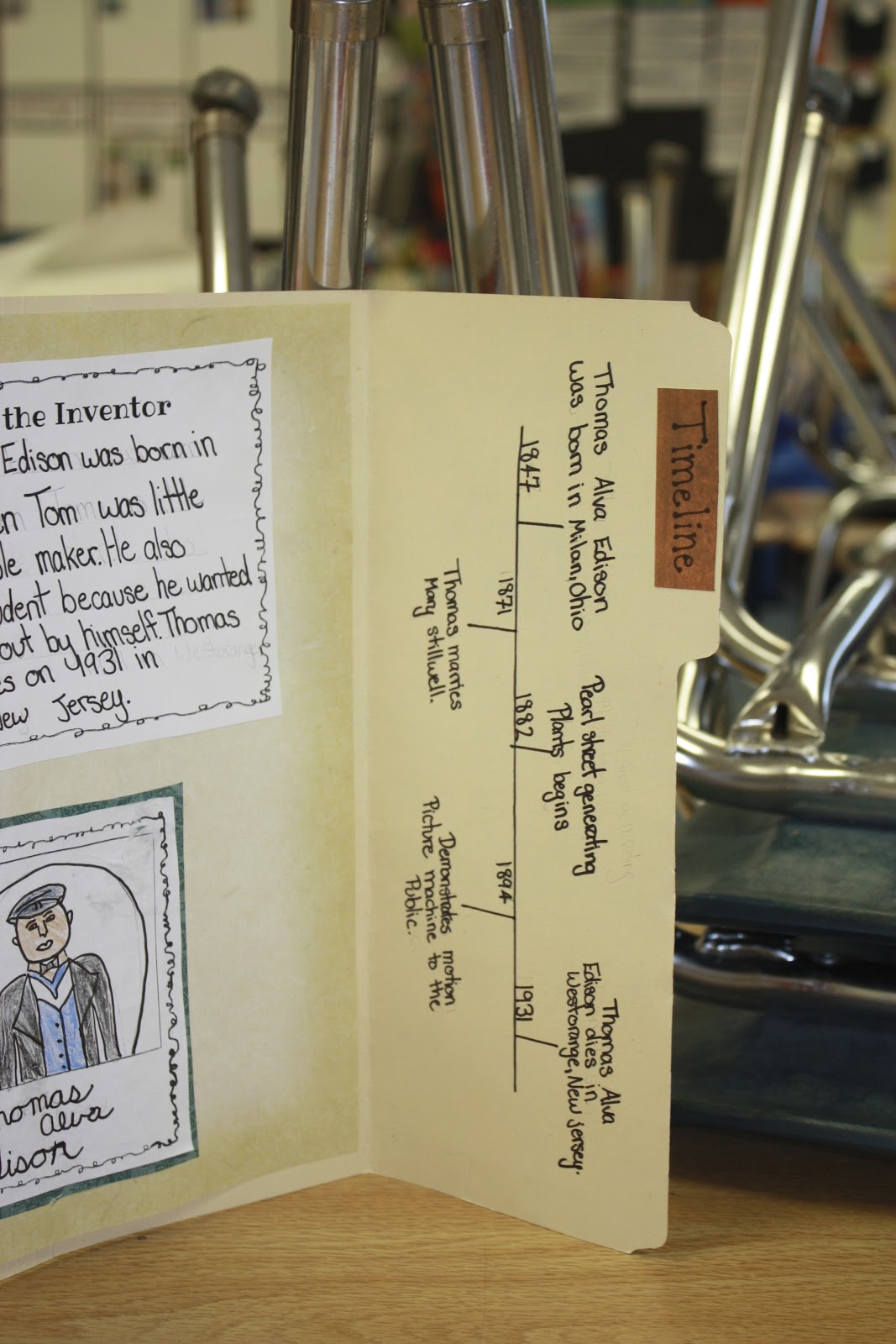
One of my new Common Core ELA Units is called "Figure it Out."  It is about notable people who overcame challenges to become successful in life.  We read about Helen Keller, Leonardo da Vinci, George Washington Carver and Thomas Edison.

We created lap-books using an Invention Brochure that I bought on TPT from This Little Piggy Reads.  The printables fit nicely on the file folder.  Here are some samples of my student's work.  I made a sample but allowed my students to use their own creativity.  It also fits in with our electricity unit.